
Travel Writing
How to Write a Travel Narrative: A Step-by-Step Guide
Learn how to write a travel narrative with a clear scene, a turning point, and an ending that shows what changed.
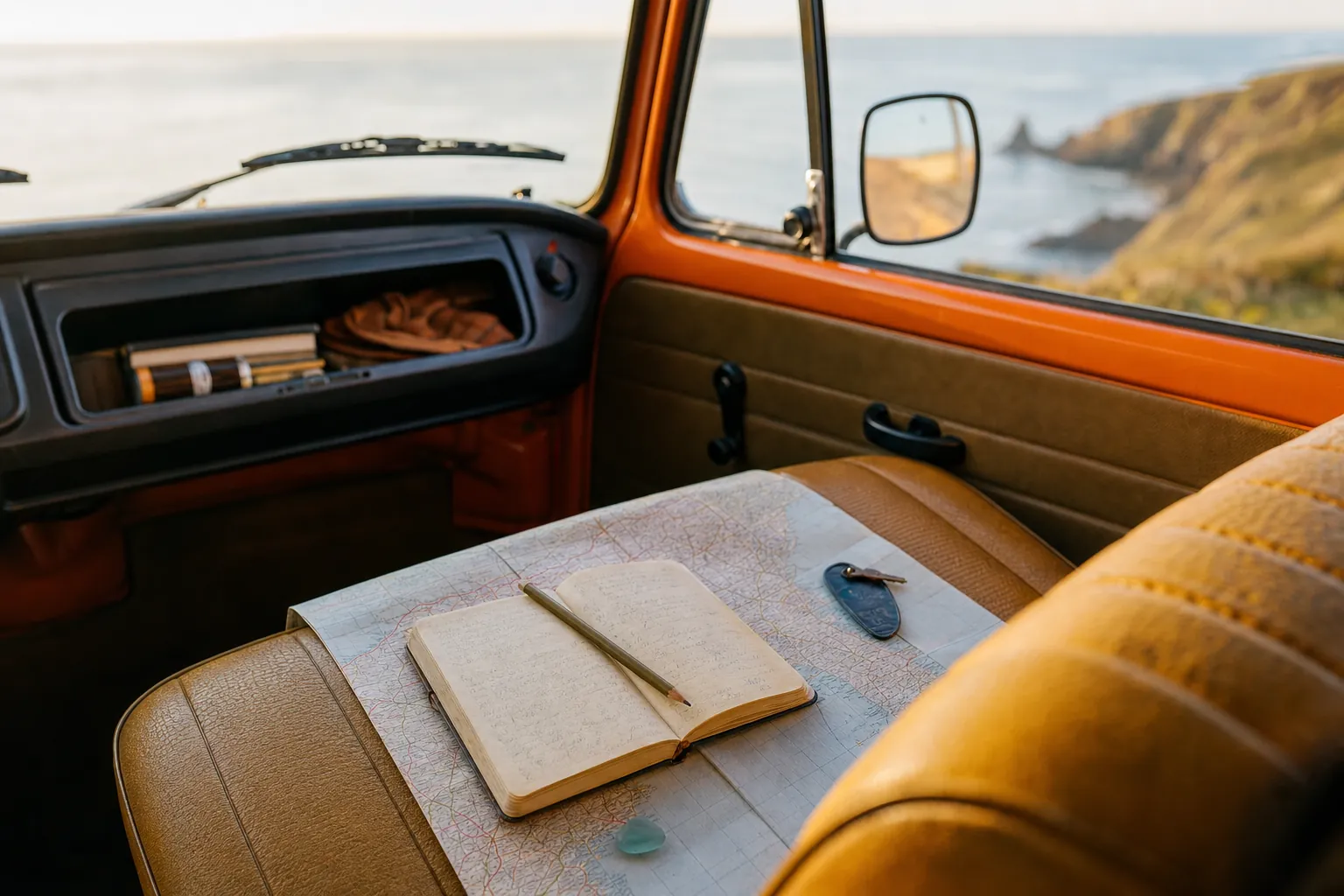
What is a travel narrative?
A travel narrative is a true story shaped from a journey. It puts a reader inside a place through scenes, details, people, and reflection, then follows the change that gives the trip meaning. It can begin on a long road, a ferry, a familiar beach, or a walk through an old neighborhood.
Unlike a travel guide, which helps someone plan where to go and what to do, a travel narrative lets the reader experience a place through one person's eyes. It may include useful context, but its engine is a story rather than an itinerary. For a broader introduction to the form, start with the Journal's guide to travel writing.
A simple travel narrative has three moves: begin with a specific scene, follow the moment that changes the journey, then end by showing what the traveler sees or understands differently. The rest of this guide helps you build those moves without flattening the trip into an itinerary.
A trip is not yet a story. It is a pile of miles, receipts, weather, wrong turns, meals, strangers, and small moments that might become something if you can find the one that still tugs at you after you get home.
That is the useful difference between a travel narrative and a trip report. A report tells a reader where you went. A narrative lets them ride along long enough to feel the heat through the windshield, wonder whether the last motel has a vacancy, or understand why an ordinary stretch of road stayed with you. Travel literature can take many forms, including memoir, essay, guidebook, and travelogue; a narrative works best when the journey creates a change worth following. EBSCO’s overview of travel literature is a useful reminder that the genre makes room for both the outward route and the writer’s way of seeing it.
You do not need an exotic destination, a disaster, or a lifetime of mileage. You need one honest experience, enough detail to make it visible, and the nerve to leave out the parts that only prove you were there.
Begin with a moment that has pressure
Do not start with “Last summer, my family and I went to...” unless the sentence immediately breaks open into a moment. Readers do not yet know why the trip matters, so give them something they can feel before you hand them the map.
Look for pressure. It may be obvious: the van overheats, the ferry leaves without you, the rain erases the plan. It may be quieter: a familiar beach has changed, a relative says something that will not leave your mind, or you arrive expecting one thing and discover another. Narrative is not just description. It needs a sequence of events, a point of view, and some consequence. Writing Commons’ narrative-writing guidance makes the same practical point: concrete, meaningful detail has to serve the story, not merely decorate it.
Write down three moments from the trip that still carry a charge. Put them in present tense without explaining them. “The motel sign keeps blinking after midnight.” “The gas gauge has been below empty for fifteen miles.” “My father is standing in the surf with his shoes on.” The one that gives you the next question is usually the beginning.
In G.J.’s Rude Awakening Road Trip (Part 1), the road is not a cheerful backdrop for a vacation list. Money, distance, and the stubborn facts of an old vehicle give the journey stakes. That is why the reader keeps moving with it.
Choose one route through the material
A first draft often tries to honor every stop: breakfast, museum, lunch, sunset, hotel, repeat. The result may be accurate, but accuracy alone does not create shape. A travel narrative needs a route through the experience, not a receipt-by-receipt inventory.
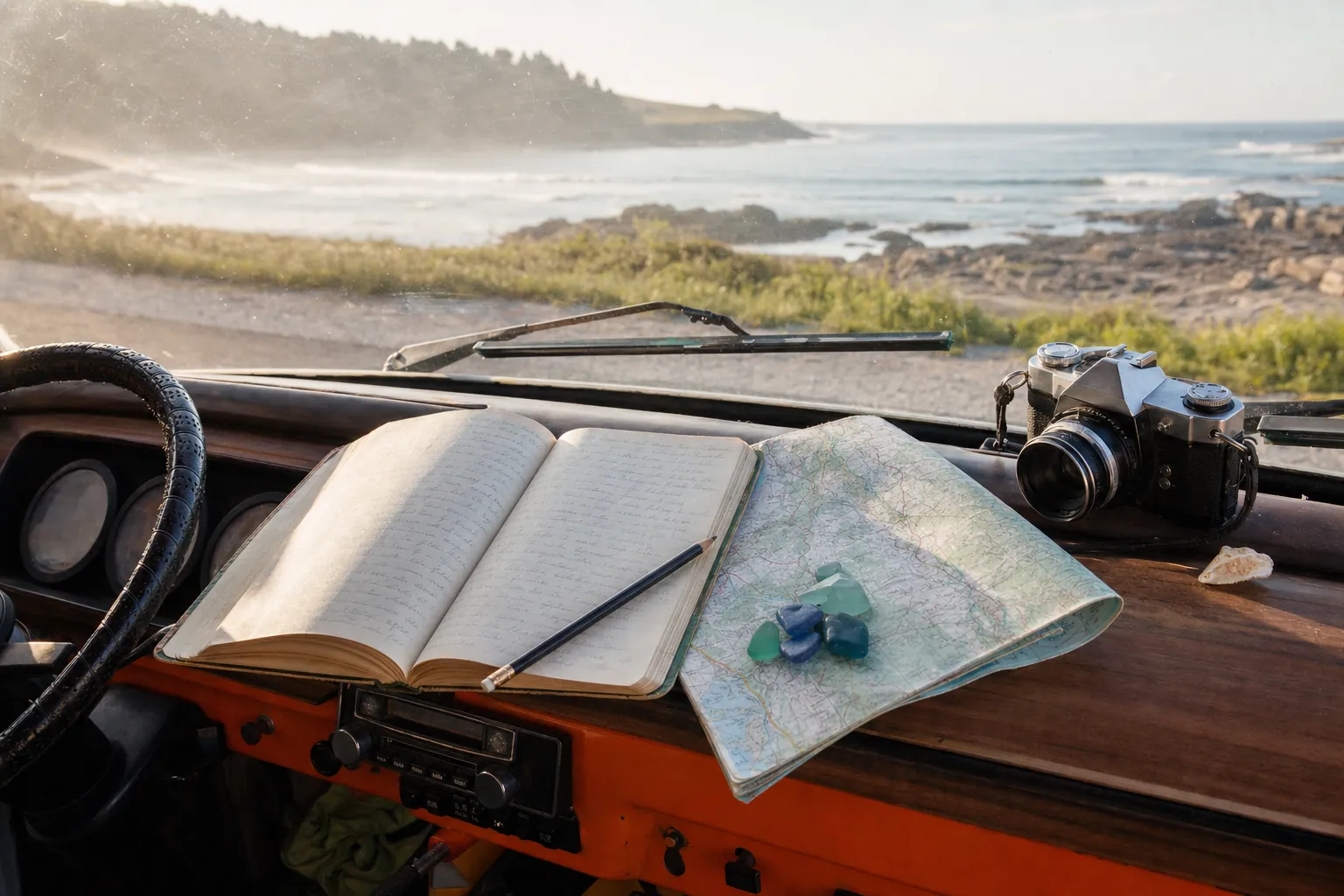
Choose a simple story spine: an expectation collides with reality; a plan goes sideways; a familiar place changes meaning; a person becomes the compass; or an object such as a map, key, van, photograph, or piece of glass gathers meaning as the story goes.
Then make a cut list. What could disappear without changing the story? The second coffee shop, the routine traffic, the hotel lobby that taught you nothing, the scenic overlook that looked like every other scenic overlook. Keep the details that change the weather of the piece. A reader will happily follow a small journey if it feels chosen.
The first Journal guide, Travel Writing Examples: Make a Place Come Alive, shows how a precise detail can carry a scene. Here, take the next step: decide what that scene is doing. Is it setting up a promise? Complicating it? Letting the narrator see something they had missed?
Build scenes instead of summaries
Summary moves the reader quickly: “We drove all day and finally reached the coast.” Scene slows down for the part that matters: “At the last gas station before the water, the clerk pointed at our map with a damp thumb and told us the bridge was closed.” Both have a job. Summary carries ordinary miles. Scene carries the moments where the story turns.
A workable scene needs a place the reader can locate, a person doing something, one or two sensory details, and a change by the end. Give them the dashboard, the cracked pier, the wet motel walkway, the bus seat, or the diner booth. Let someone choose, wait, lie, drive, listen, argue, or notice. Then let the weather turn, the plan alter, or the narrator understand a little more.
Too much scenery can flatten a narrative as easily as too little. Replace broad labels such as “beautiful,” “weird,” “authentic,” or “breathtaking” with the thing that earned the label. Was the beach beautiful because the tide left glass in the sand? Was the town strange because nobody hurried except you? Let the reader reach the feeling through evidence.
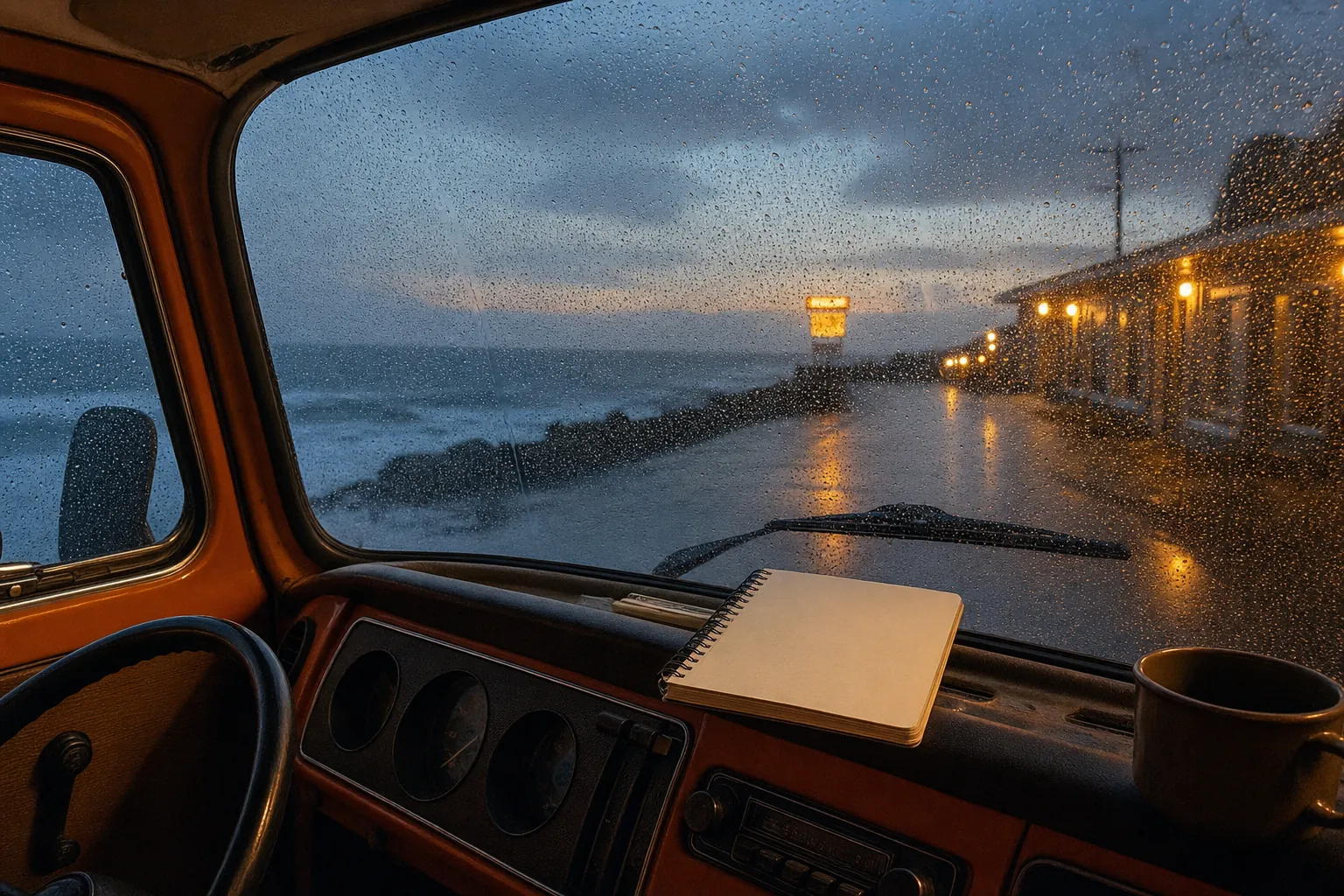
When dialogue belongs in the scene, use only the line that changes the air. The University of North Carolina Writing Center’s advice on quotations is useful beyond school papers: set up the speaker, give enough context, and do not make a quote carry the whole meaning on its own.
Let the narrator be present without taking over
A travel narrative is not a brochure, but it is not a diary dump either. The reader needs to know whose eyes are on the road. Your habits, assumptions, impatience, delight, fear, and sense of humor make the experience a story rather than a generic account.
First person is often the natural choice because the writer is part of the journey. Still, “I” is not the subject of every sentence. Let the narrator appear through selection: the snack bought at the gas station, the directions you distrust, the song stuck in your head, the destination you refuse to admit you miss. Writing Commons’ explanation of point of view is worth keeping in mind. Perspective shapes what the reader notices and how the place is understood.
That is also where humility matters. A weekend does not make anyone an authority on a community. Let local people be people rather than scenery. Check the facts that support the piece. Attribute stories that are not yours. Admit what you do not know. The closer a writer observes, the less they need to pretend.
G.J.’s Key West - In Loving Memory works because the place is not a collection of postcard claims. It is tangled with memory and lived experience. The destination stays vivid because the narrator has a relationship to it.
Gather field notes that can become scenes
Good travel notes are not a second job. They are a way to keep the small evidence that memory throws out first. A phone note, a receipt with a sentence written on the back, a voice memo at a stoplight, or five lines in a cheap notebook can be enough.
- Write one exact image. Not “a pretty harbor,” but “green rope piled beside a lobster trap with a yellow glove caught in it.”
- Write one sound or smell. The compressor kicking on, bait warming in the sun, chlorine in a motel stairwell.
- Write one line of speech. Record it exactly when possible, then note who said it and why it mattered.
- Write one change. What shifted in the plan, the weather, the relationship, or your understanding?
- Write one question. What are you still trying to figure out about the place or yourself?

These notes give you choices later. You may not use the coffee ring, bus ticket, or cracked plastic key tag. But one of them may become the ordinary object that holds the story together. In Road Trippin’, the pleasure of the journey comes from the movement and the attitude around it, not from an exhaustive record of each mile.
Find the turn before you write the ending
Most travel narratives become clearer when you can name the turn. It is the point after which the trip cannot feel exactly as it did before. The turn may be external: the road closes, the person leaves, the storm wins, the old bus refuses. Or it may be internal: you stop trying to control the day, forgive someone, recognize home in a place you thought you had outgrown, or understand that the trip will not fix what you brought with you.
Write one sentence in this form: “I thought this journey was about ___, but it became about ___.” Do not put that sentence in the final draft unless it sounds natural. Use it as a compass. It tells you which moments belong before the turn and which moments should come after it.
A story does not need a grand lesson. It needs an ending that acknowledges the change. Return to an image from the opening if you can, but let it mean something slightly different now. The same motel sign, piece of glass, road, or passenger seat can close the circle without tying it into a fake bow.
For a larger example of a vehicle becoming a character in the journey, the Prelude to a Groovy Road Trip page introduces Vinnie van Go, a 1970 VW love bus with opinions of his own. When an object keeps returning with new weight, it can hold the shape of a travel narrative surprisingly well.
Revise for movement, not mileage
On the first revision, read only for motion. Underline every place where something happens, changes, or becomes clearer. Put a question mark beside every paragraph that merely repeats the itinerary. Then ask whether a scene, a detail, or a clean cut would serve the reader better.
On the second revision, read for language. Trade abstractions for objects. Cut the sentence that announces the emotion after the scene has already shown it. Watch for travel-brochure language: “hidden gem,” “must-see,” “unforgettable,” “paradise.” These phrases tell the reader how to feel instead of giving them a reason.
Finally, read it aloud. Your ear catches when the story pauses to explain too much, when a paragraph has no rhythm, or when the ending arrives a sentence too late. The useful goal is not a perfectly polished version of the trip. It is a truthful version that carries a reader from one moment to the next.
Start with a road you already know
You do not need a passport stamp to write a travel narrative. Write the ferry route you have taken for years, the road out of town, the beach after a storm, the old neighborhood you drive through differently now, or the first trip that taught you a plan could become a story.

Blue Sea Glass is built from that kind of attention: Long Island, Key West, old roads, sea glass, poems, and the odd lesson gathered when the direct route is not the best one. Browse the writing archive for more places to begin. Choose one moment with pressure, write the scene before you explain it, and follow the point where the journey changes course.
Frequently asked questions
Travel narrative questions
What is a travel narrative?
A travel narrative is a true story shaped from a journey. It uses scenes, details, people, and reflection to show what happened and why the experience mattered to the person telling it.
How is a travel narrative different from a travel guide?
A travel guide helps someone plan where to go and what to do. A travel narrative puts the reader inside one person’s experience of a place. It may include practical context, but the main engine is a story rather than an itinerary.
Do I need a dramatic trip to write a travel narrative?
No. A delayed ferry, a familiar beach, a walk through an old neighborhood, or a roadside meal can make a strong narrative when something changes in the moment and the writer notices what made it matter.
How long should a travel narrative be?
Start with the length the story can hold. A vivid scene with a clear turn may work in 800 words; a larger journey may need several thousand. Every section should move the story, deepen the setting, or sharpen the reflection.
Keep wandering
Related posts
 Travel Writing
Travel Writing Examples: 5 Short Scenes That Bring a Place Alive
Five short travel writing examples with practical notes on adding vivid detail, tension, voice, and a shape that keeps readers moving.
 Travel Writing
How to Write a Travel Article That Takes Readers Along
A scene-first method for turning a real trip into a travel article with a strong angle, useful notes, and a satisfying finish.
 Travel Writing
What Is Travel Writing? A Guide to Seeing the Road
An introduction to travel writing: what it is, what it does, how it differs from a guidebook, and the details that make a place stay with a reader.