
Travel Writing
Travelogue Examples: 5 Ways to Make a Journey Matter
Five travelogue examples that show how a real trip can become a story with a scene, a point of view, and a reason to keep going.

A travelogue does not need a distant country, a flawless itinerary, or a mountain of photographs. It needs a journey that changes shape when you look at it closely. The place can be a Florida motel after rain, a ferry you have taken for years, a stretch of Long Island shore, or a road that was supposed to lead somewhere else.
Merriam-Webster defines a travelogue simply as a piece of writing about travel. That leaves a lot of room, which is useful. A good travelogue can be funny, reflective, rough around the edges, or quietly observant. Its real job is to bring a reader into a particular experience, then leave them with the feeling that the miles meant something.
What makes a travelogue worth reading?
The weak version of a travelogue is a diary of motion: we left at eight, ate lunch at noon, saw the museum, checked into the hotel, went home. Nothing is wrong with those facts, but they do not yet give a reader a reason to stay. The stronger version chooses the moments that reveal the weather of the trip: the gas gauge dropping, the bridge closed by a storm, the stranger with an opinion about the road ahead, or the one view that changes how home looks on the way back.
Think of a travelogue as a collection of selected evidence. You choose the detail that lets the reader hear the diner, smell the wet upholstery, see the salt on the windshield, and understand why the moment mattered to you. The distance traveled is less important than the attention paid.
These travelogue examples are invented scenes, but each one uses the same material real travelers already have: a place, a problem, an object, a person, and a shift in understanding. Take the approach that resembles your own trip, then replace the sample details with the ones only you could have noticed.
1. Begin where the plan breaks
Flat version: "We drove down the coast, but rain made us stop at a motel."
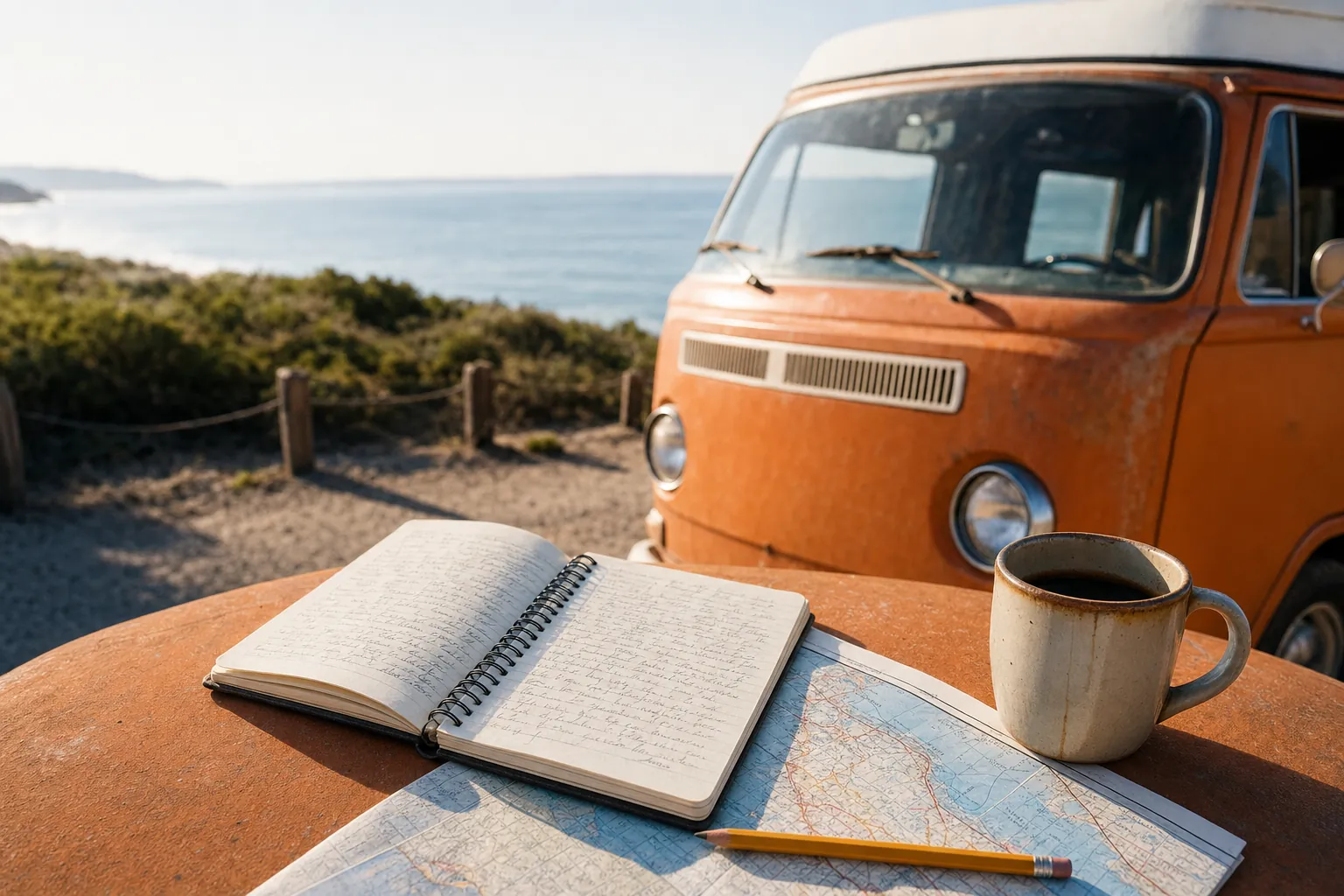
Travelogue version: "The rain started just as the map told us to leave the coast. By the time the motel sign appeared, the wipers had given up keeping pace. The clerk handed us a plastic key marked 12 and looked past us at the orange van as if he had seen our kind of plan before."
The second version starts at a point of pressure. The reader does not know whether the travelers are stranded, embarrassed, relieved, or all three, but they can feel the plan sliding sideways. That uncertainty is enough to pull the scene forward.
You do not need a disaster. A small interruption works: a missed ferry, a wrong turn, a road closure, a dinner that does not arrive, or a friend who suddenly wants to turn back. A trip becomes a story when something forces the traveler to choose. G.J.'s Rude Awakening Road Trip (Part 1) understands this well. The dream is big, but the bus, the money, and the road have their own ideas.

2. Let one object carry the place
Flat version: "The beach was beautiful and we found sea glass."
Travelogue version: "Near the rocks, my hand closed around one small piece of blue glass, worn soft enough to look like it had been in the water longer than any of us had been alive. I put it in my pocket, then spent the rest of the walk feeling for it every few minutes, as if it might explain why I had come back."
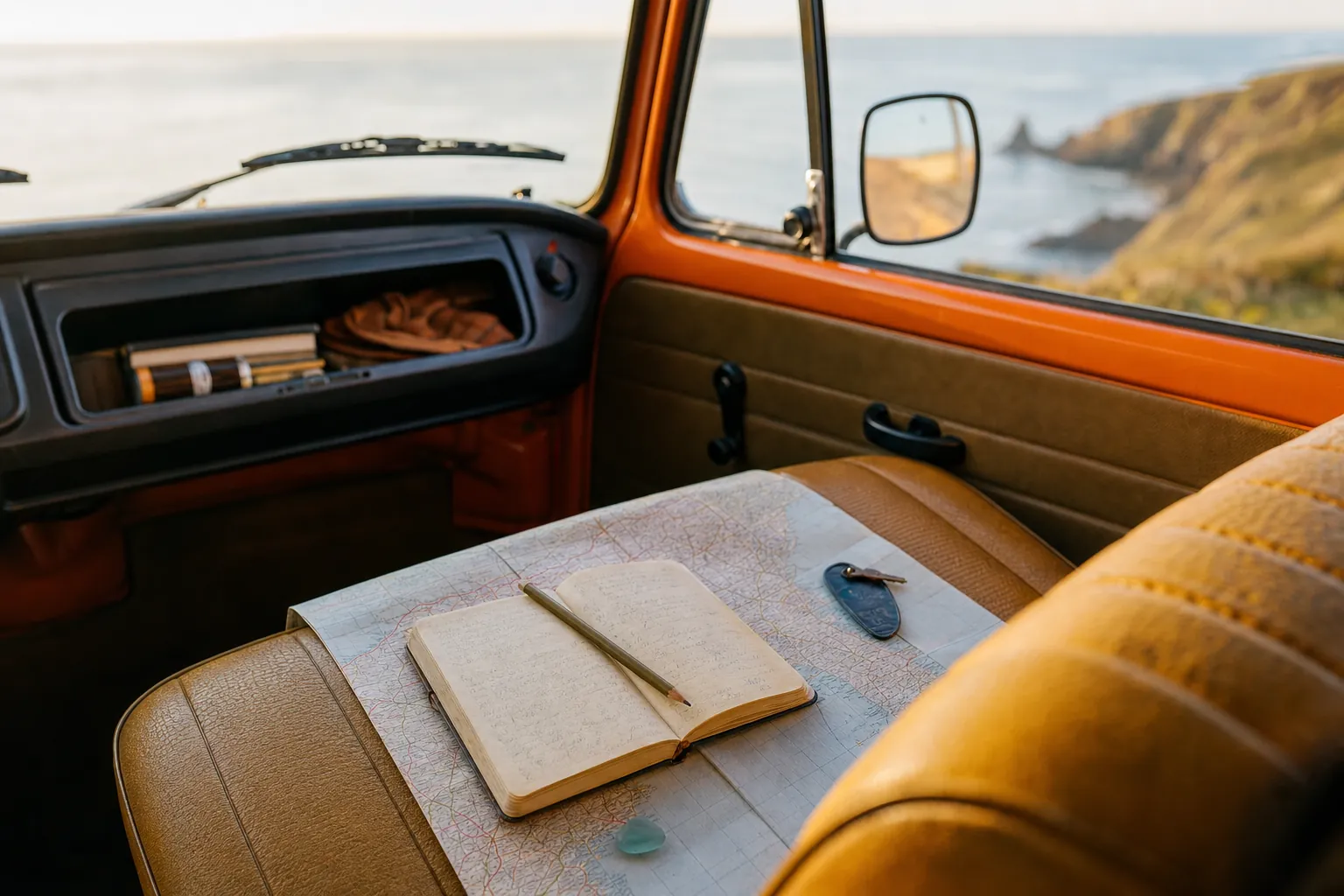
An object makes a useful anchor because it stays in the reader's hand. It can be a bus ticket, motel key, folded map, empty bottle, shell, photograph, or strange snack bought at a gas station. Describe it precisely, then let the object open toward a larger feeling. Do not announce the feeling too soon. Let the reader notice the blue glass, the worn edges, and the way the traveler keeps checking for it.
Blue Sea Glass is built on this kind of attention. In Blue Sea Glass and Other Rare Finds, small beach finds become a doorway to memory, people, and time. The object is not important because it is expensive or rare. It matters because the traveler gives it a story.

3. Use another person to reveal the road
Flat version: "A local told us where to eat."
Travelogue version: "At the bait shop, the woman behind the counter looked at our map, turned it upside down, and told us the road we wanted was fine unless the tide was coming in. 'Then it belongs to the water,' she said, already reaching for the next customer."
People make a place feel inhabited. A good travelogue does not collect strangers as colorful decorations, though. Give a person a useful action, a few exact words, or a piece of knowledge that changes the scene. Let them remain a person with their own life, not just a prop who appears to make the writer look adventurous.
Sometimes the best travel companion is the person already in the vehicle. They may be too cheerful, too tired, suspicious of every shortcut, or so quiet that their silence changes the whole car. The road puts people under small pressure, and those small pressures reveal character. That is why a travelogue can be about a relationship as much as a destination.
When you use dialogue, provide the setting around it. A single line lands better when the reader knows who is speaking, where they are standing, and why the words matter. The University of North Carolina Writing Center's guidance on quotations makes the same practical point: context gives a reader the circumstances needed to understand the words.
4. Return to a place with a changed pair of eyes
Flat version: "I went back to the town where I grew up, and it was different."
Travelogue version: "The bakery was still on the corner, but the windows had been painted black and the bell over the door no longer rang. I stood across the street waiting for the old smell of bread to come back to me. What arrived instead was the sound of traffic and the odd realization that I had remembered the place more clearly than I had ever known it."
Returning is one of the oldest travelogue moves because it gives the writer two versions of the same place: what it was then, and what it is now. You do not have to explain all the history. Put one memory beside one present detail and let the gap speak.
This works for a hometown, a childhood beach, a former apartment, or the route to a place you once loved. G.J.'s Key West - In Loving Memory shows how a location can be more than scenery when it is tangled with a lived chapter of a person's life. The travelogue becomes richer when the route has emotional baggage in the back seat.
Be fair to the place. Change does not automatically mean decline, and nostalgia can turn a town into a cardboard set. Let the present have its own life. The stranger at the new counter, the changed shoreline, or the street that now moves too fast may tell a truer story than trying to restore the old one on the page.
5. End with the trip still moving inside you
Flat version: "We had a great trip and I will never forget it."
Travelogue version: "Back home, I left the motel key in the cup holder for two weeks. Every time I got in the car, it clicked against the change and took me back to the rain, the bad coffee, and the road we had not meant to take. Eventually I threw it away. The sound stayed."
A travelogue does not need a giant lesson at the end. It needs an image or action that shows the journey has changed its meaning. The reader should feel that the traveler has arrived somewhere, even if that somewhere is only a clearer question.
Look back at the object, problem, or line of dialogue from the beginning. Can it return with a slightly different weight? The map that first promised control may look foolish by the end. The blue glass may become a reminder of someone. The vehicle that seemed like a problem may reveal itself as the reason the journey had any story in it at all. In Prelude to a Groovy Road Trip, the old VW is never just transportation. It is part companion, part troublemaker, and part reason the road has a voice.
How to turn your trip into a travelogue
Start by avoiding the urge to tell everything in order. Lay out your notes, photographs, receipts, messages, and scraps of memory. Then look for what still has a charge. It may be the first thing that went wrong, the person you keep mentioning, the item you brought home, or the place that looked nothing like your expectation.
- Choose one central moment. Begin with the scene that makes you ask what happens next.
- Collect concrete details. Write down what you saw, heard, smelled, touched, and carried before you decide what it means.
- Use summary only for the ordinary miles. Slow down for scenes where the plan, a person, or your understanding changes.
- Keep your point of view honest. A travelogue is not a guidebook or a sales brochure. Say what you experienced, and leave room for what you could not know in a short visit.
- Find the return. End on the image, action, or question that shows the trip did not simply disappear when the car stopped.
Writing Commons' overview of narrative is useful here: a beginning, middle, and end do not require an elaborate plot. They simply give the reader a movement to follow. Your travelogue can be small as long as it moves from one state of understanding to another.
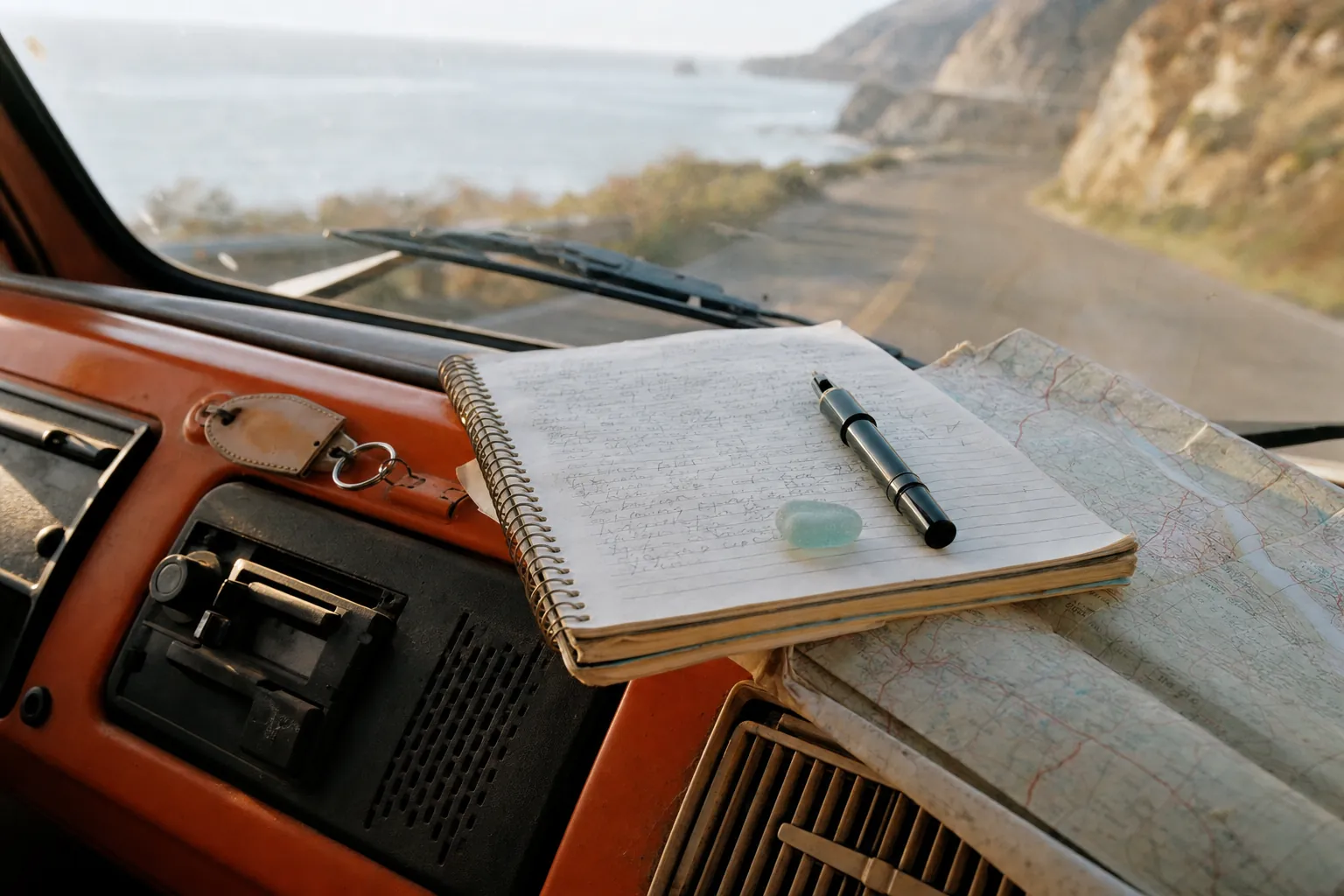
Before you call the draft finished, read it once with a pencil beside you. Mark the lines that could belong to anybody's trip, then trade them for the thing you actually saw or heard. A travelogue earns its place through particulars: the wet map, the orange dashboard, the quiet after an argument, or the blue glass you carried home.

Start with the miles you already have
The best travelogue examples do not make every stop sound extraordinary. They notice the one stretch of road, one beach find, one awkward meal, or one companion's silence that made the journey specific. The destination may be far away. It may also be a few miles from home.
Browse the writing archive for G.J.'s stories of Key West, the road, beachcombing, and the odd turns that make ordinary miles worth keeping. Then write one scene from your own route before the details get smoothed over. The trip does not have to be grand. It only has to be true enough for a reader to ride along.
Frequently asked questions
Travelogue questions
What is a travelogue?
A travelogue is a written account of travel. It can cover a whole journey or one small stretch of it, but the memorable versions give readers more than a list of stops. They show what the traveler noticed, what happened, and why the place stayed with them.
What should a travelogue include?
Include the details that make the journey particular: a setting, a few sensory details, people or voices, a change in the plan, and your honest perspective. You do not need to include every stop. Choose the moments that carry the story.
How is a travelogue different from an itinerary?
An itinerary tells readers where you went and when. A travelogue lets them experience part of the trip with you. It uses scene, selection, and reflection so the route has a human shape instead of reading like a schedule.
Can I write a travelogue about a familiar place?
Yes. Returning to a hometown beach, taking the same ferry in a different season, or driving an old road after years away can make a strong travelogue. Familiarity gives you a useful before-and-after view that a first visit cannot always provide.
Keep wandering
Related posts
 Travel Writing
Travel Writing Examples: 5 Short Scenes That Bring a Place Alive
Five short travel writing examples with practical notes on adding vivid detail, tension, voice, and a shape that keeps readers moving.
 Travel Writing
How to Write a Travel Narrative: A Step-by-Step Guide
Learn how to write a travel narrative with a clear scene, a turning point, and an ending that shows what changed.
 Travel Writing
How to Write a Travel Article That Takes Readers Along
A scene-first method for turning a real trip into a travel article with a strong angle, useful notes, and a satisfying finish.