
Travel Writing
Travel Writing Prompts: 20 Ideas for Real Stories
Twenty travel writing prompts for finding scenes, memories, and small turns worth carrying into a story.

Travel writing prompts work best when they lead you away from the postcard version of a place and toward the part only you could tell. The right start might be a wet motel key, a road you did not mean to take, a sentence overheard in a diner, or the moment a familiar shoreline looked different than it did years ago.
Do not try to answer every prompt like a school assignment. Choose one, write quickly, and stay with the physical details. A good first draft does not need to cover the whole trip. It needs one moment with enough weather, feeling, and uncertainty to make a reader wonder what comes next.
1. Write about the first thing that went wrong
Begin with the flat tire, missed ferry, bad directions, closed bridge, or forgotten reservation. Let the trouble reveal the place and the people traveling through it. The useful question is not whether the problem was dramatic. It is what it made possible, awkward, expensive, funny, or unexpectedly kind.
2. Describe a place through one object
Choose an object that could not have come from anywhere else: a sun-faded menu, a plastic motel key, a rusted dock cleat, a beach toy stuck in sea grass, or a coffee cup with a chipped handle. Describe it closely, then let it open into the wider place.
3. Write the road you almost skipped
Think of the turnoff, side street, back road, or small town you nearly passed. What made you stop? What did you expect to find? The contrast between expectation and arrival gives a travel story a natural shape.
4. Start with a sound
Write the ferry horn before dawn, gulls behind a fish market, a car that should not be making that noise, rain on a camper roof, or a stranger laughing in the next booth. Stay with the sound long enough for the reader to enter the scene before you explain where they are.
5. Remember a meal that became part of the trip
It does not have to be a grand meal. Write the vending-machine dinner, the gas-station snack, the pie at a roadside counter, or the meal someone insisted you try. Give the food a job in the story: comfort, disappointment, delay, celebration, or proof that you had reached somewhere new.

6. Return to a place you knew before
Write about going back to a beach, street, cabin, neighborhood, or town that had changed, or that made you realize you had changed. Do not try to explain all the history at once. Put the old memory and the present detail beside each other, then let the difference do the work.
7. Write about the person who knew the place better than you did
It may be a taxi driver, motel clerk, shop owner, relative, park ranger, or person at the next table. Give them one gesture, line of speech, or piece of practical knowledge. Let them stay a person, not a colorful prop. What did they notice that you missed?
8. Begin with the weather changing the plan
Weather is useful when it has consequences. A storm cuts short a walk, heat makes everyone short-tempered, fog hides the landmark, or wind turns a beach day into a scramble. Describe the change as it happens, then follow the choice it forces.
9. Write the view that disappointed you
A travel piece does not need to be a string of beautiful places. Write about the famous lookout that was crowded, the beach that was smaller than memory, or the attraction that left you cold. The more interesting question is why you expected something else and what the disappointment exposed.
10. Follow a piece of advice you did not trust
Someone tells you to take a road, avoid a restaurant, wait for the tide, or skip the obvious attraction. Write the moment you decide whether to listen. Advice gives the story another voice and a small point of tension before the destination even arrives.

11. Give the vehicle a role in the story
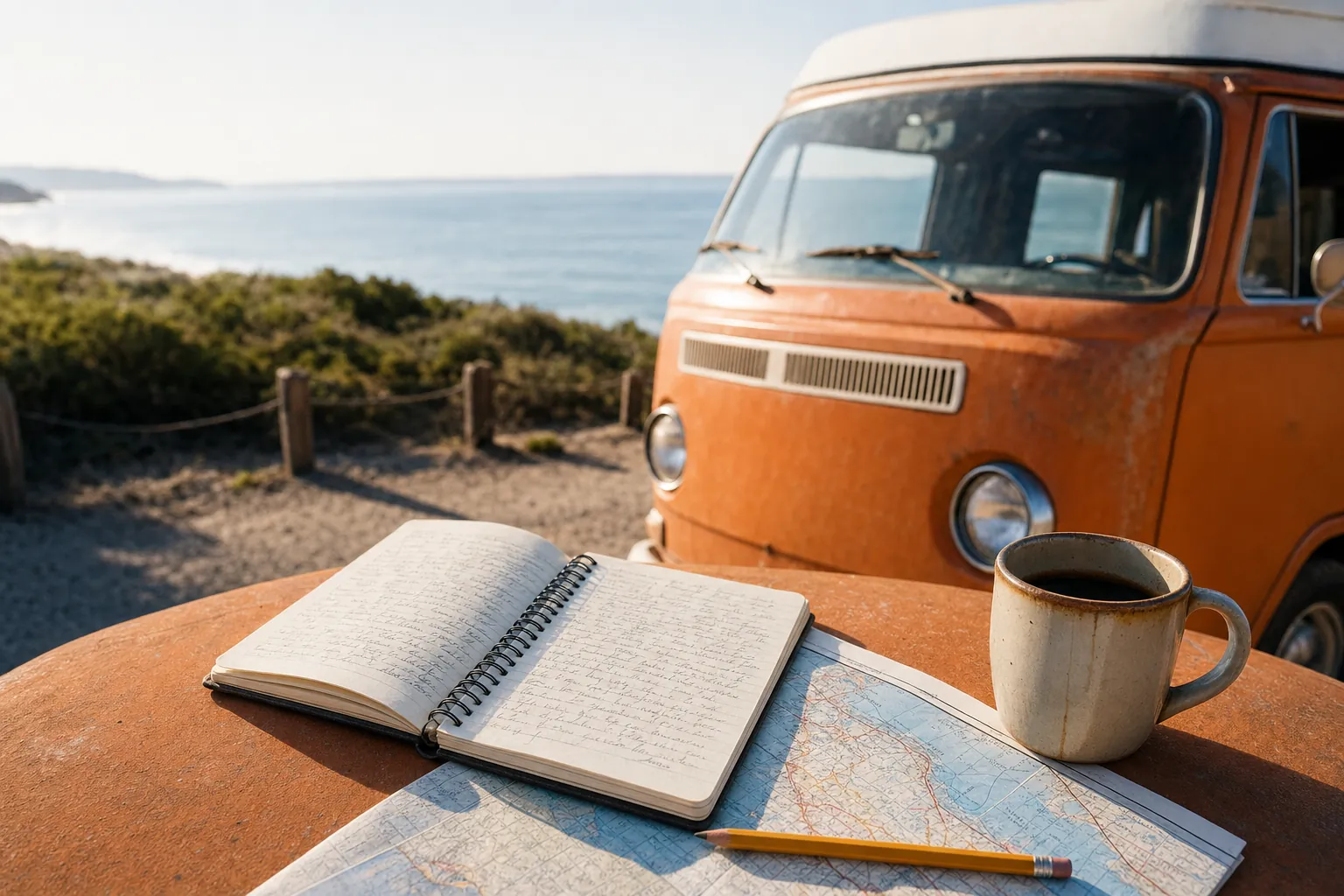
A car, bus, bike, boat, or old camper can be more than transportation. Write the way it smelled, sounded, misbehaved, or set the pace for everyone else. In G.J.’s Prelude to a Groovy Road Trip, Vinnie van Go is part companion, part problem, and part invitation to keep moving.
12. Write a map memory
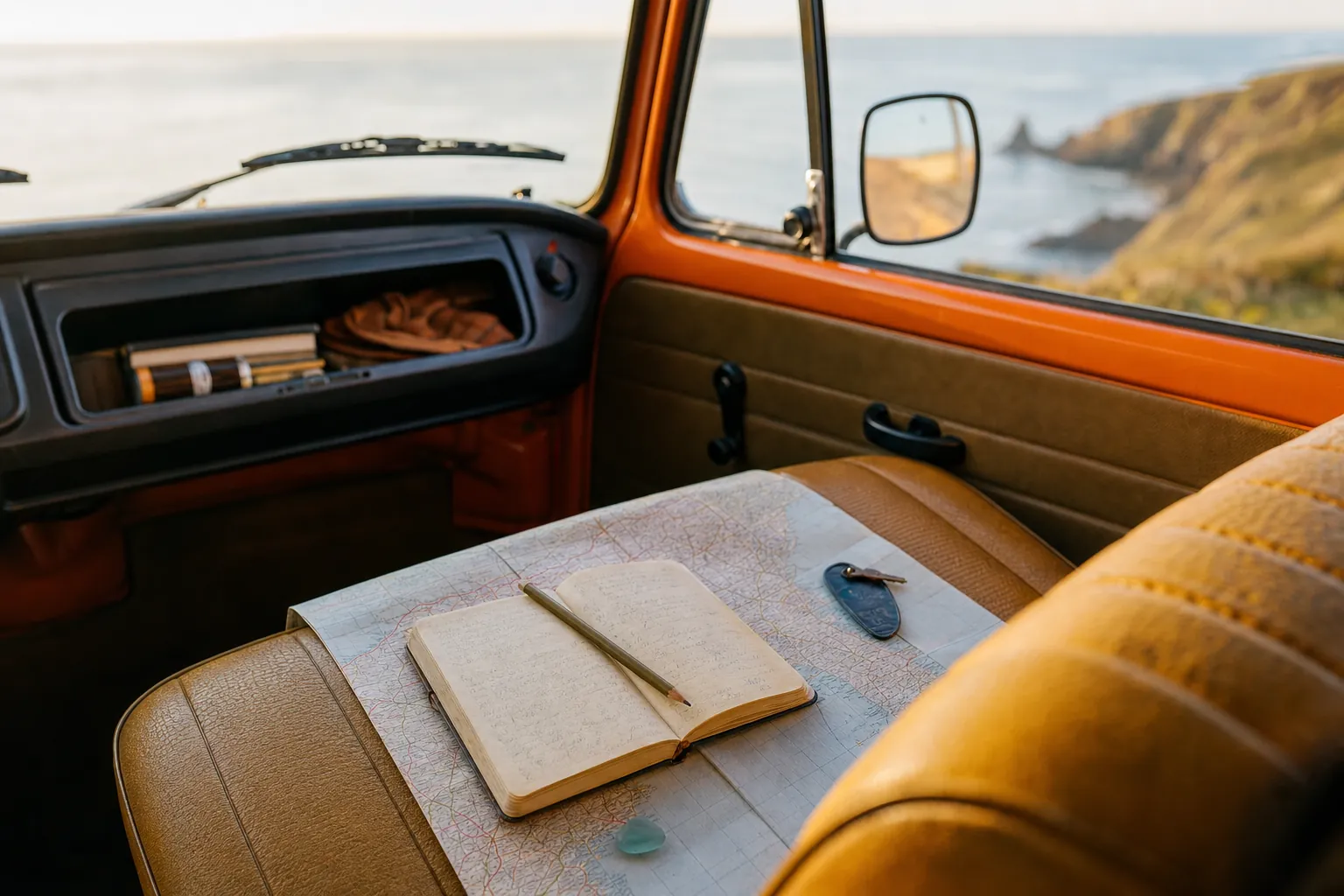
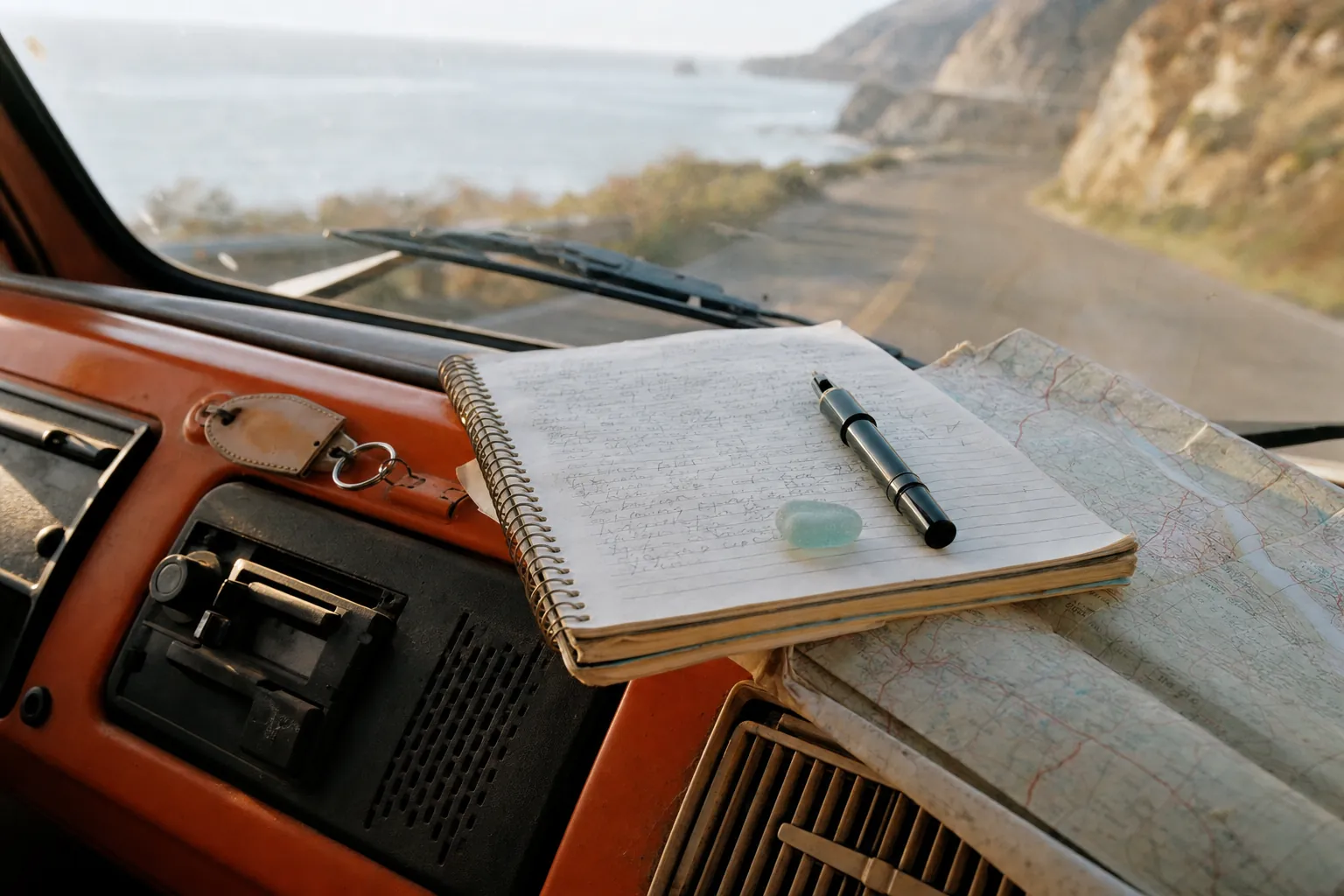
Start with a paper map, phone screen, handwritten directions, or the realization that you are lost. Maps promise control, which makes them especially useful when the trip refuses to behave. What route did you plan, and what route did you actually take?
13. Tell the story of one piece of sea glass
Write about finding something small on a shore or trail. Where was it? Who saw it first? What did it look like in your hand? A modest find can hold a large memory because it gives the reader something physical to carry through the piece. G.J.’s Blue Sea Glass and Other Rare Finds begins from that kind of close attention.
14. Write about waiting
Travel contains more waiting than most people admit: for luggage, rain, a table, a bridge to open, a companion to return, or an old engine to decide whether it will start. Let the waiting stretch the scene. Notice what people do when there is nowhere else to be.
15. Start with the sentence you heard and cannot forget
Use the exact words when you can, then build the scene around who said them and what changed after. A line of dialogue can bring a stranger close, but it needs a setting and a consequence. Do not let it float by itself.

16. Write the place at the edge of the day
Choose dawn, closing time, blue hour, or the first dark mile after sunset. Those thresholds make ordinary places feel unsettled and sharp. Show what the light hides, what it reveals, and why the traveler is still there.
17. Describe a local rule you did not understand
Maybe you were told not to park somewhere, not to swim past a point, not to order a dish a certain way, or not to trust a particular road after rain. Ask what the rule protects and who carries that knowledge. Curiosity is better company than certainty.
18. Write a souvenir that did not survive
Lost tickets, broken shells, stained postcards, faded photographs, and objects left behind can make a richer story than a perfect keepsake. What did the missing object represent? Why does the loss stay with you?
19. Tell the story of going home
The return trip is often where a journey reveals its real subject. Write the first familiar sign, the pile of laundry, the changed view from the driveway, or the silence after the car stops. What did you bring back besides a bag and a few photographs?
20. Write the trip you would take again
Do not explain why it was perfect. Rebuild one moment from it: the first stop, the wrong turn that became lucky, the person who made the day, or the sight that made everyone quiet. Let the reader feel why the road still calls you back.
Turn one prompt into a story
After you choose a prompt, write one scene before you reach for the whole itinerary. Give the reader a place, a person, an object, and a change. Then ask what the moment puts at stake. A missed turn can become a story about control. A beach find can become a story about memory. A tired meal can become a story about the people who kept going.
If you need a model for building that scene, the Journal’s travel writing examples show how detail and tension give a place shape. The travel narrative guide can help when you have material but do not yet know where the story turns.
A fifteen-minute way to use a prompt
Set a timer and make the first five minutes about evidence. List what the place looked like, what it sounded like, what the air smelled like, what you were carrying, and what someone said. Do not decide what the story means yet. Meaning arrives more easily when the page has something solid under its feet.
For the next five minutes, choose the detail that seems to have a little pressure behind it. Maybe it is the motel key you did not want, the shore you had not seen since childhood, or the road that made everyone in the car go quiet. Put yourself back in that moment and write it in order. Let the reader see what you saw before you tell them how to feel about it.
Use the final five minutes to find the turn. Ask what changed while the scene unfolded. Did the plan shift? Did someone reveal something? Did you understand the place, or yourself, a little differently? End with the next action, image, or question rather than a lesson. You can always add context during revision, but a live scene is harder to recover once it has been explained away.
When the timer ends, underline the one sentence that still feels charged. That sentence may be the opening of the longer piece. G.J.’s travel writing tips offer a next step for collecting the notes and shaping them into a draft that can carry the rest of the journey.
Keep prompts close to the road
Save the prompts that make you reach for a memory right away. Keep them in the back of a notebook, on your phone, or beside the camera you take on a trip. The aim is not to turn every stop into material. It is to have a good question ready when a small moment begins to feel larger than it first appeared.
On a longer trip, try choosing only one prompt for the day. It can keep you observant without turning the experience into a chore. At day’s end, write a few lines while the details are still fresh: the light, the sound, the odd object, the bit of dialogue, and the thing that did not go to plan. Later, you can decide whether those notes belong to one story or several.
Some prompts will lead nowhere, and that is useful information too. A false start may show you that the real story is not the scenic overlook but the argument in the parking lot before it, or not the restaurant but the person who showed you how to find it. Follow the material that keeps giving you another question.
Start with the long way around
Blue Sea Glass has always made room for the side road, the worn notebook, the odd roadside stop, and the little finds that outlast the plan. Browse G.J.’s writing archive for stories from Key West, the road, and places that stayed with him. The best prompt is usually the one that sends you back to a moment you thought was too small to matter.
Frequently asked questions
Travel writing prompt questions
What makes a good travel writing prompt?
A useful prompt gives you a narrow door into a real moment. It should send you toward an object, a person, a problem, or a change you can describe instead of asking you to summarize an entire trip.
Do travel writing prompts work for places close to home?
Yes. A familiar beach, bus route, diner, or road can make a strong travel piece because you can notice what has changed and what it means to you. Distance is less important than attention.
Should I answer every part of a travel writing prompt?
No. Treat the prompt as a starting point, not an assignment. Follow the detail that brings the most energy to the page, even if the resulting story heads somewhere you did not expect.
How long should I write from one prompt?
Start with ten or fifteen minutes and stay inside one scene. If the material keeps opening up, write longer. The first goal is to find a live moment, not to finish a polished story in one sitting.
Keep wandering
Related posts
 Travel Writing
Travel Writing Examples: 5 Short Scenes That Bring a Place Alive
Five short travel writing examples with practical notes on adding vivid detail, tension, voice, and a shape that keeps readers moving.
 Travel Writing
How to Write a Travel Narrative: A Step-by-Step Guide
Learn how to write a travel narrative with a clear scene, a turning point, and an ending that shows what changed.
 Travel Writing
How to Write a Travel Article That Takes Readers Along
A scene-first method for turning a real trip into a travel article with a strong angle, useful notes, and a satisfying finish.