
Travel Writing
Travel Writing Structure: Shape a Journey Into a Story
A practical travel writing structure for choosing a live moment, building a middle, and ending a journey with meaning.

A travel story can begin with a small piece of trouble: rain finding its way through a camper window, a motel key that feels wrong in your hand, a beach you remember better than it exists, or a road that asks you to turn back. The important thing is not the size of the trip. It is the moment that gives the reader a reason to move with you.
That is what structure does. It does not turn a real journey into a formula. It gives the details a direction, so a reader can feel where they are, what is changing, and why the last image matters. Without a shape, even a remarkable trip can become a string of meals, miles, and snapshots. With one, a ferry ride, a long drive, or an afternoon on a familiar shore can become a story.
Start with the question inside the trip
Before you organize anything, find the question that still has some charge. It may not be a question you asked at the time. You may only recognize it later. Why did a simple road trip start to feel like a test? Why did a place you loved suddenly seem unfamiliar? Why did a stranger's ordinary advice stick with you longer than the landmark you went to see?
That question is the spine of the piece. It helps you choose what belongs and what can fall away. “We drove to Key West” is an itinerary. “The old van made us slow down long enough to notice what we had been rushing past” is a possible story. The second idea has movement built into it. The reader can sense that something will be tested and that the destination is not the only point.
Try writing three sentences that begin, “This trip became a story when...” Finish each one without worrying about style. Maybe the answer is a missed turn, a companion's silence, a storm, a found object, or the uneasy feeling of going back somewhere after years away. Choose the sentence that makes you want to know what happened next. That is your opening door.
G.J.'s Rude Awakening Road Trip (Part 1) has a clear question beneath the miles. The dream of the open road meets money, distance, and an old VW with ideas of its own. The route becomes readable because it keeps putting pressure on the people who thought they knew where they were going.
1. Open in a moment, then give the reader just enough road
The first paragraph does not have to explain the entire trip. In fact, it usually should not. Begin where the air changes: the rain is already coming down, the last ferry is leaving, the car has started making a sound nobody wants to name, or the person beside you says something that changes the day.
Place the reader in that moment with two or three specific details. Let them see the wet dashboard, hear the motel ice machine, or feel the grit underfoot at the edge of the water. Then give only the background needed to understand why the scene matters. A sentence or two can establish where you are, who is with you, and what you had expected. Everything else can wait.
A useful opening carries a small promise: this situation is going somewhere. It does not require a disaster. The trip may be quiet. But a quiet piece still needs a little tension between expectation and reality. The road was supposed to be easy. The hometown beach was supposed to feel unchanged. The plan was supposed to make sense. Let the reader discover why it does not.

For more ways to build an opening scene, use the Journal's travel writing examples. The strongest examples do not begin with a claim that a place was beautiful. They begin with the concrete evidence that lets the reader arrive before the writer explains what the place meant.
2. Build the middle around three moves
The middle is where travel writing often turns into a diary. The writer feels obliged to report every stop because each one really happened. A reader does not need the complete record. They need the few moments that develop the question from the opening.
A simple three-move middle is often enough. First, show the original expectation. Second, introduce the moment that complicates it. Third, let the traveler respond. The pattern is flexible, but it keeps the piece from sitting still.
- Expectation: Show what the traveler wanted, assumed, or planned. The map says the road is open. The town is remembered as quiet. The day is supposed to be a break from everything else.
- Complication: Let the place push back. Weather changes, a bridge closes, a conversation redirects the route, an old memory no longer matches the present, or the vehicle insists on becoming part of the story.
- Response: Show what the traveler does with that change. They wait, turn around, listen, argue, notice, give up control, or see a familiar place differently.
This does not mean you need to invent drama. It means you have to recognize the pressure that was already there. A detour can reveal impatience. A delayed meal can show who keeps the mood light. A beach find can open a memory. A rainy motel can become the moment everyone finally admits the plan has failed. Structure comes from choosing the meaning in the material, not from making the material louder than it was.
The Journal's guide to travel narratives is useful when you have plenty of memories but no clear route through them. Its central advice is simple: let the trip's turning point decide which scenes deserve room.
3. Slow down for scenes and use summary for the miles between
Travel writing needs both scene and summary. Summary moves quickly: “We drove through the afternoon and reached the coast after dark.” Scene slows down: “At the last gas station before the water, the clerk folded our map in half and said the bridge had been closed since noon.”
Use summary to cross ordinary distance, cover routine information, or orient the reader in time. Use scenes for the moments where something changes. In a scene, someone has to do something. A person drives, waits, refuses, points, remembers, or notices. The place needs to be present too. Give the reader a physical setting, one sensory detail, and an action that shifts the moment by the end.
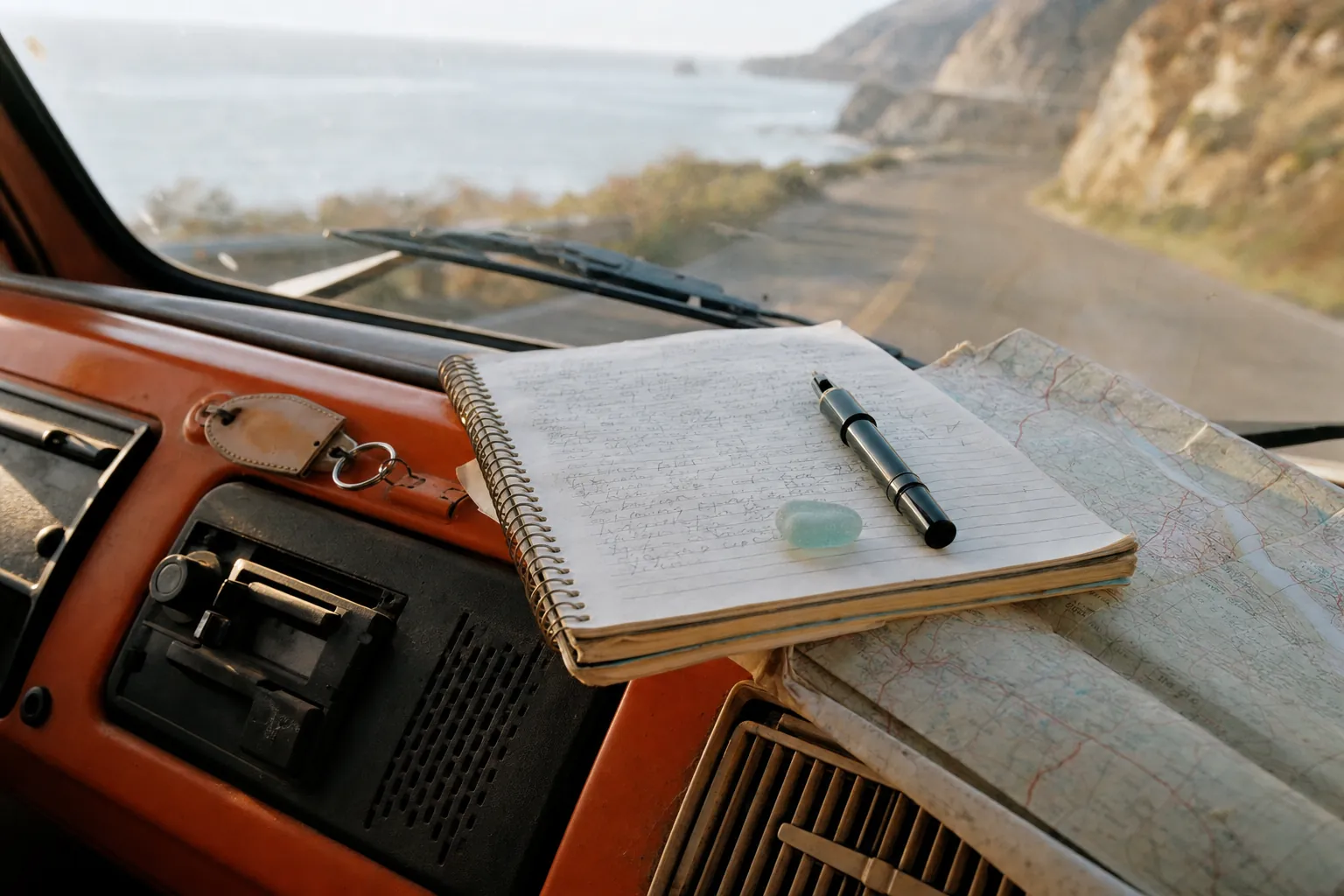
Writers sometimes avoid scene because it feels slower, but speed is not the point. A scene gives a reader a place to stand. It also gives you room to let a detail carry meaning without explaining it immediately. A plastic key tag, a wet map, a broken windshield wiper, or a piece of blue glass can become more than an object when the reader first encounters it at the right moment.

Keep summary honest and clean. Do not turn it into a list of every restaurant, town, and road sign. The Purdue travel-writing workshop makes the same practical case for selecting representative moments instead of trying to cover an entire trip. Choose the scenes that earn their place, then let summary do the quiet work between them.
4. Give the piece one thread that keeps returning
A long trip naturally produces a pile of material. One way to keep it from scattering is to notice what returns. The thread can be an object, a line of dialogue, a weather pattern, a song on the radio, a vehicle, or an idea the traveler cannot shake. It should arise from the trip itself, not be forced on it like a school assignment.
Blue Sea Glass understands the force of an ordinary object. In Blue Sea Glass and Other Rare Finds, a small find can hold a larger memory. In a travel piece, a map may first represent control, then become useless after the road closes. A motel key may first feel like defeat, then become the thing you keep in your pocket after the day turns around. The object does not have to announce its symbolism. It gains meaning through return.
Dialogue can be a thread too. A short phrase from a local, relative, clerk, or travel companion can follow the writer through the journey. Give it context the first time it appears, then let it echo later when the reader understands it differently. The University of North Carolina Writing Center's guidance on quotations offers a useful reminder: a speaker's words need enough surrounding context to carry their real meaning.
Do not pack in five threads. One is enough. The repeating detail gives your reader something to recognize as the trip changes shape.
5. End where the meaning has shifted
A travel piece does not need to tie the trip into a grand lesson. Readers can feel when an ending has been pushed too hard. The better ending usually returns to an image, action, or question from earlier in the story and lets it carry a little more weight.
Maybe the writer drives home with the same map that first promised an easy route, but now it is folded along the road they actually took. Maybe the beach find is sitting in a cup holder two weeks later. Maybe the motel key is thrown away, but the night it represents is still there. The final image should suggest that the traveler has arrived somewhere different, even when the change is small.
Before you write the ending, ask one plain question: What did the journey reveal that was not clear at the beginning? The answer may be about a place, a friendship, a loss, a memory, or the writer's own habits. You do not have to state it outright. Let the final scene do some of the work. The reader should be able to feel the difference between the opening and the last paragraph.

For a larger example of a vehicle holding a journey together, visit Prelude to a Groovy Road Trip. The VW is never only transportation. It is companion, complication, and a reason the road develops a personality of its own.
Use this travel writing structure on the trip you already have
You do not need an exotic destination to use this structure. Try it with a ferry ride, a childhood beach, a trip to the next town, a rainy drive, or a route you have taken so often that you no longer notice it. Begin with the moment that has a question. Choose three moves that develop it. Slow down for the scenes that change something. End with the image that lets the reader feel what stayed.
G.J.'s work gives this method a real home. His writing moves through Long Island, Key West, sea glass, old roads, and a vintage camper that rarely behaves like a neutral piece of equipment. Browse the writing archive for those original stories, or use the travel writing prompts when you need a narrow way into your own material. The trip does not have to be grand. It needs a moment that matters, and enough shape for a reader to travel through it with you.
Frequently asked questions
Travel writing structure questions
What is the basic structure of travel writing?
A useful travel piece usually has a beginning that puts the reader in a live moment, a middle that develops the pressure or discovery, and an ending that shows what the journey changed. The route may be short, but the reader still needs a movement to follow.
Should travel writing follow the trip in order?
Not necessarily. Chronological order can work, but only when each stop builds the same question. Often it is stronger to begin at the most charged moment, then use brief background to orient the reader before moving through the scenes that matter.
How many scenes does a travel story need?
There is no fixed number. A short piece may need one fully developed scene and a little reflection, while a longer one may use three or four scenes. Keep the scenes that reveal place, create a choice, or change the writer's understanding.
How do I end a travel writing piece?
End with an image, action, or thought that carries a different weight than it did at the start. You do not need a grand lesson. A motel key left in a cup holder, a changed view of home, or a road that now means something else can be enough.
Keep wandering
Related posts
 Travel Writing
Travel Writing Examples: 5 Short Scenes That Bring a Place Alive
Five short travel writing examples with practical notes on adding vivid detail, tension, voice, and a shape that keeps readers moving.
 Travel Writing
How to Write a Travel Narrative: A Step-by-Step Guide
Learn how to write a travel narrative with a clear scene, a turning point, and an ending that shows what changed.
 Travel Writing
How to Write a Travel Article That Takes Readers Along
A scene-first method for turning a real trip into a travel article with a strong angle, useful notes, and a satisfying finish.