
Travel Writing
Types of Travel Writing: Find the Shape of Your Story
Seven types of travel writing, with practical ways to choose the form that gives your journey a clear purpose and a reader a reason to stay.

Travel writing is a roomy house. A road can hold an itinerary, a confession, a piece of reporting, a love letter to a city, or a story about the moment a plan went wrong. That freedom is useful, until it leaves a writer staring at a notebook full of good details and no idea what belongs on the page.
The answer is not to force every journey into the same shape. First decide what the reader needs. Do they want help going somewhere? Do they want to feel what it was like to be there? Do they want to understand a place, a person, or a question the trip brought to the surface? The form follows that job.
Search results often group travel writing under one label, but writers and editors use many overlapping forms. Reedsy’s overview of travel-writing forms makes the practical point well: the shape of a piece helps a writer match it to the reader and the place where it will appear. Here are seven useful forms, along with a simple way to choose among them.
1. The practical guide
A practical guide helps someone make a decision or a plan. It answers questions such as where to stay, how to get around, what to pack, which trail to take, or how much time an experience needs. The writer’s personal voice can still appear, but the reader’s next move comes first.
Use this form when your best material is useful information. A beachcombing guide, for example, should help a reader choose a shore, understand local rules, and prepare for a safe day outside. The personal story belongs only where it makes the advice clearer. Blue Sea Glass’s beachcombing resources page works this way: it gives a curious reader a practical starting point rather than asking them to follow a memoir.
Choose it when: a reader could act on the page tomorrow. Keep it honest: separate what you know firsthand from facts that need checking, and do not hide the useful answer under a long opening scene.
2. The destination feature
A destination feature gives a reader a sense of a place through one sharp angle. The angle might be a neighborhood’s late-night food, a town’s old motels, a ferry route, a local festival, or the way a coast feels after a storm. It is narrower than a whole-city guide and more outward-looking than a private diary.
The feature needs reporting habits: observe closely, check your facts, attribute what people tell you, and avoid treating residents as scenery. A piece about Key West might begin with heat on the pavement or a conversation at a counter, then open into a small history or a local practice. The place has to remain more than a backdrop for the visitor’s feelings.

Choose it when: you have one subject inside a larger destination. Try this first: write a one-sentence promise that names the place, the angle, and why it matters now.
3. The personal travel essay
A personal travel essay uses a journey to examine an inner question. The road matters, but the piece is really about what the writer notices, misunderstands, loses, finds, or comes home knowing differently. It is not a permission slip for vague feelings. A reader still needs scenes, people, objects, and a sense of movement through time.
This is often the right form when the trip changed your understanding of something larger: family, grief, home, aging, friendship, desire, or the limits of a plan. Start with a live moment, not a summary of the entire vacation. The Journal’s travel narrative guide can help you find that moment and give it a beginning, middle, and ending.
Choose it when: the strongest question belongs to the traveler. Watch for: reflection that arrives before the reader has seen enough of the actual journey to feel it.
A note on truth, memory, and the reader’s trust
Every type of travel writing makes a promise. A guide promises useful help. A feature promises a fair look at one part of a place. An essay promises an honest account of what the journey meant to one person. The promise does not require a flat, report-like voice, but it does require care about what happened, what was remembered later, and what has been learned from somebody else.
Memory is allowed to be personal. It is not allowed to turn other people into convenient characters or a whole place into a mood board. If you remember a conversation, say enough about the circumstances for a reader to understand its limits. If you use history, check it. If you are passing through, let that modest fact shape the size of your claims. The best travel writing earns intimacy through attention, not certainty.
That discipline also gives the prose more life. Instead of calling a coast magical, name the salt on the railing, the grocery bag snapping in the wind, or the motel sign with one letter out. Instead of announcing that a town changed you, show the small action you could not have imagined taking before you arrived. The detail is what lets the reader make the journey alongside you.
Before you publish, read once for usefulness and once for fairness. Can a reader tell which details are observed, remembered, or researched? Have you given the people in the piece enough context to be understood as people, not color? That brief final check protects both the story and the trust that makes a reader return.
4. The travelogue
A travelogue is the old, durable form of a journey told in motion. It can be a book, a long article, or a series of linked entries. The route gives it a natural spine, but a good travelogue does not mistake chronology for structure. “Then we went here” is a map, not yet a story.
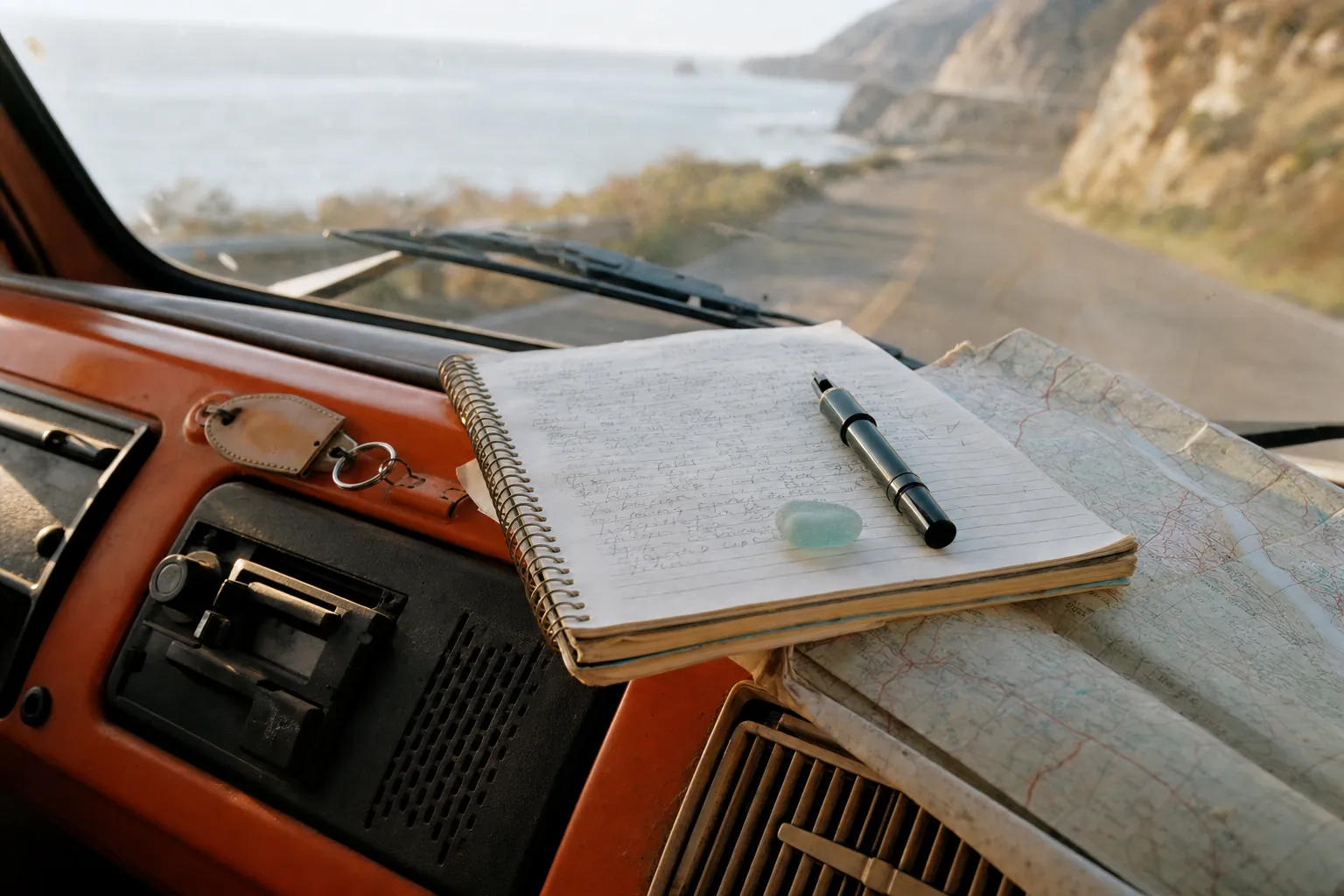
Give the route a pressure point. Maybe the vehicle is unreliable, the budget is thin, the weather changes the plan, or the traveler is trying to reach someone before it is too late. In Kaspar’s story, the old Volkswagen camper is not just transportation. Its quirks, repairs, and stubborn charm create choices that a clean rental car never would.
Choose it when: the movement itself creates the story. Build it around: a few scenes that change the journey, then summarize the necessary miles between them.
5. The travel memoir
Travel memoir reaches farther than a single trip. It uses travel as a thread through a period of a life. A place may return years later with a different meaning, and the writer may move between present-day scenes and remembered ones. The form makes room for distance, revision, and the fact that memory does not arrive in a neat line.
The difference between memoir and a personal essay is usually scale. An essay may turn on one journey or realization. A memoir has time to show a longer pattern, including the versions of the writer who did not yet know what the story meant. That makes selection especially important. A memory earns its place when it changes the larger thread.

Choose it when: several journeys belong to one larger life story. Ask before including a memory: does it reveal the central change, or is it merely a pleasant detour?
6. The special-interest story
A special-interest story follows a passion through a place. The subject might be sea glass, old buses, regional food, birding, architecture, trains, fishing, bookstores, or a local tradition. The journey gives the reader access to the subject, while the subject gives the journey focus.
This form is useful because it replaces the broad claim, “Here is everything about this place,” with a more believable invitation: “Here is one way to see it.” A reader interested in a shore can meet it through the search for a worn piece of glass. A reader interested in an old vehicle can meet a road through its maintenance, limits, and personality. The narrower lens often makes the piece richer.
Choose it when: a specific fascination is doing the real work. Keep it balanced: let the place and the people encountered remain real, not props for the hobby.
7. The reported travel story
A reported travel story uses the writer’s movement through a place to understand something beyond the writer. It may explore a community, an environmental change, a local industry, a historic tension, or the consequences of tourism itself. The traveler can appear, but the story’s authority comes from careful reporting, not simply from having visited.
This is the form that requires the most humility. Speak to people with relevant experience, check facts against dependable sources, say what you do not know, and let local voices carry their own meaning. Writer’s Digest notes that travel articles take different structures, but all of them benefit from discipline about what a scene can honestly prove.
Choose it when: the journey opens onto a public question. Do not choose it merely because: a place feels important. Importance needs evidence, voices, and context.
How to choose the right form for your material
Put your notes in front of you and circle what has the most energy. If the notes are full of usable advice, write a guide. If one part of a town keeps pulling your attention back, write a feature. If one awkward moment changed the way you saw yourself, write an essay. If the route, vehicle, or series of setbacks created the tension, you may have a travelogue.
When you cannot choose, draft two openings. Write one paragraph that gives practical advice and one that puts the reader inside a scene. The stronger paragraph will usually reveal the form. You can also use the Journal’s travel writing prompts to discover whether your material wants a memory, an object, a voice, or a turning point.

Let the form serve the reader, then let the details do their work
The categories are tools, not cages. A good personal essay may include a little history. A practical guide may open with a story. A travelogue may pause for a well-reported portrait of a place. The point is to know what carries the weight, so the reader never has to wonder why a detail is there.
Blue Sea Glass grows from the kind of material that crosses forms naturally: shorelines, road miles, old vehicles, found objects, Key West memories, and the moments that refuse to become ordinary. For a visual road story in pictures and poems, start with Prelude to a Groovy Road Trip. For shorter pieces, wander the writing archive. Take the form that fits the story you actually have, not the trip you wish you had taken.
Frequently asked questions
Types of travel writing questions
What are the main types of travel writing?
Useful working types include the practical guide, destination feature, personal essay, travelogue, memoir, special-interest story, and reported piece. A real article can borrow from more than one, but choosing its main job keeps the reader oriented.
What type of travel writing should a beginner try?
Start with a short personal travel essay or a focused destination feature. Both let you work from one scene instead of trying to cover every stop on a trip. Choose a moment with a small change, then use a few details to make the place visible.
Is a travel blog the same as travel writing?
A travel blog is a place to publish, not one fixed form. It can hold a practical guide, a personal essay, an itinerary, a review, or a reported story. The useful question is what the reader needs from the particular post.
Can one travel story use more than one form?
Yes. A road story may use a little practical guidance, history, and personal reflection. Give one purpose priority, however. If the reader needs help planning, make the guidance easy to find. If the reader comes for a story, keep the scene and its change at the center.
Keep wandering
Related posts
 Travel Writing
 Examples: 5 Short Scenes That Bring a Place Alive
Five short travel writing examples with practical notes on adding vivid detail, tension, voice, and a shape that keeps readers moving.
 Travel Writing
How to Write a Travel Narrative: A Step-by-Step Guide
Learn how to write a travel narrative with a clear scene, a turning point, and an ending that shows what changed.
 Travel Writing
How to Write a Travel Article That Takes Readers Along
A scene-first method for turning a real trip into a travel article with a strong angle, useful notes, and a satisfying finish.